1. The Hook: Wait—How Did Cancer Medicines Suddenly Double Their Score in One Year?
Imagine your school track team has been trying to beat the four-minute mile for thirty years. Every spring, your fastest runner shaves off two tiny seconds, everyone claps politely, and the trophy stays on the shelf. Then, in the fall of 2026, seven different runners walk onto the track wearing four strange new kinds of shoes—and all seven of them smash the record by forty-five seconds in the exact same month!
If you saw that happen on a real track, you wouldn’t just cheer. You would grab a magnifying glass and ask two questions right away:
- “What on earth is inside those new shoes?”
- “Hold on—did somebody shorten the track when we weren’t looking?”
That exact mystery just happened in the real world of cancer medicine in late 2026. For decades, when scientists tested a brand-new medicine for tough, late-stage cancers (like pancreatic, ovarian, lung, or head-and-neck cancer), doctors and Wall Street investors were used to small, heartbreakingly slow steps: the typical new drug helped patients live about 2 to 3 months longer than old-school chemotherapy, and lowered the monthly danger of dying by about 15% to 30% (a score doctors write as a Hazard Ratio of 0.70 to 0.85).
Then, between August and October 2026—capped off by the giant European cancer conference (ESMO 2026) and two blockbuster late-October trial readouts from Genmab—a wave of Phase 3 clinical trials dropped numbers that made cancer doctors rub their eyes in disbelief. As biotechnology analyst Ohad Hammer (@ohadhammer) summarized in a widely shared October 2026 oncology breakdown:
“So far 2026 has been a great year for oncology drug development. News flow has been the strongest in years and results from ESMO and other recent readouts suggest the field is experiencing a robust innovation cycle. This is driven primarily by progress with topo1 ADCs, RAS inhibitors and T cell engagers. What’s interesting this time is not just the amount of successful P3s [Phase 3 trials] but the magnitude of benefit in broad populations (as opposed to biomarker selected studies). Historically, investors were used to increases of 2–3 months in overall survival and HRs of ~0.7, but just in 2026 there have been multiple readouts with HRs of 0.4–0.5!”
Cutting the risk of dying by 50% to 60% (HR = 0.40 to 0.50)—and doubling survival time in deadly diseases like metastatic pancreatic cancer from 6.7 months to 13.2 months—is an enormous leap. Today, we are going to put on our detective hats. First, we will build every single concept from the ground up so a smart 5th grader (10–11 years old) with zero biology background can understand the exact molecular gears. Then, we will audit all seven breakthrough medicines against their official FDA, New England Journal of Medicine (NEJM), and ClinicalTrials.gov receipts to separate genuine engineering miracles from statistical optical illusions. (If you want a foundational primer on how surgery, radiation, and classic chemotherapy work first, check out our companion explainer: How Do Today’s Cancer Treatments Actually Work?).
2. Starting from Zero: How Doctors Score a Cancer Trial—and How the 4 New Smart Weapons Work
Before we look at the seven new drugs of 2026, we need to understand two things from scratch: how doctors keep score in a cancer trial, and why the four new “smart weapons” work so much better than old-school chemotherapy.
Part A: How Do You Keep Score When Lives Are on the Line?
When a company invents a new cancer medicine, the government’s referee—the U.S. Food and Drug Administration (FDA)—does not let them just give the pill to 10 people and say, “Hey, they look pretty good!” Instead, the company must run a giant championship test called a Randomized Phase 3 Clinical Trial with 500 to 700+ patients. Half the patients (picked by a computer coin flip) get the Old Best Medicine (the control group), and the other half get the New Medicine.
Doctors use three main numbers on the scoreboard:
-
The Middle-Person Clock (“Median Overall Survival” or
mOS):- The Concept in Plain Words: Imagine 100 patients with the same cancer start taking a medicine on Day 1. Doctors start a stopwatch and wait until the 50th patient—the person in the exact middle of the line—passes away. If the clock says
13.2 monthswhen the 50th person passes away, the score is13.2 months. - Everyday Analogy: Why do doctors use the 50th person in the middle instead of the regular “average”? Imagine 10 kids compare their weekly allowance. Nine kids get
$5, and one billionaire’s kid gets$1,000. The “average” allowance is$104.50—which is a total lie about what a normal kid gets! The middle kid (#5) gets$5, which tells the truth. In cancer trials, one or two lucky patients might live for 10 years, which would skew the average, so doctors always use the 50th person in the middle. - The Grown-Up Word: Doctors call this middle-person clock Median Overall Survival (
mOS). (If the stopwatch measures how long the 50th person lives before their tumor starts growing again on a scan, doctors call that Median Progression-Free Survival, ormPFS.)
- The Concept in Plain Words: Imagine 100 patients with the same cancer start taking a medicine on Day 1. Doctors start a stopwatch and wait until the 50th patient—the person in the exact middle of the line—passes away. If the clock says
-
The Daily Danger Score (“Hazard Ratio” or
HR):- The Concept in Plain Words: Comparing the middle person (#50) only looks at one single moment in the race. What if you want to compare the entire race from start to finish? Doctors calculate how fast patients are passing away each month on the New Medicine divided by how fast patients are passing away each month on the Old Medicine.
- Everyday Analogy: Imagine 100 kids ride bicycles down a steep, muddy mountain trail (Old Trail), and 10 kids crash every hour. Next door, 100 kids ride down a brand-new paved bike path with guardrails (New Path), and only 4 kids crash every hour. Divide the New Path crashes by the Old Trail crashes:
4 ÷ 10 = 0.40. A score of1.00means both trails are equally dangerous (10 ÷ 10 = 1.00, a total tie). A score of0.40means riding the New Path leaves you with only 40% of the danger—meaning it cut the risk of crashing by 60% (1.00 - 0.40 = 0.60, or60%)! - The Grown-Up Word: Doctors and statisticians call this danger-division score the Hazard Ratio (
HR). For thirty years, a Hazard Ratio of0.75(cutting death risk by 25%) was considered a big win. In 2026, four different Phase 3 trials posted Hazard Ratios between0.40and0.50—cutting the risk of dying by 50% to 60%!
-
The “Do You Need a Secret Club Pass?” Question (“Biomarker-Selected” vs. “Unselected / Broad Population”):
- The Concept in Plain Words: Every cell in your body has millions of microscopic protein “antennas” sticking out of its outer wall (remember, a single cell is about
15 micrometerswide—one-fifth the width of a75,000-nanometerhuman hair—and each protein antenna is only about10 nanometerstall, or 7,500 times thinner than a hair!). In the 2010s, most “targeted” cancer drugs only worked if a patient’s tumor had a gigantic number of one specific antenna (for example, covering 75% or more of the tumor cells). Doctors had to cut out a piece of the tumor, stain it in a lab, and turn away the 60% to 80% of patients who didn’t have enough antennas. - Everyday Analogy: It was like inventing a vacuum cleaner that only picks up crumbs if your kitchen floor is made of rare Italian marble. If you have regular wood or tile floors, you are out of luck.
- The Grown-Up Word: That antenna or DNA typo is called a Biomarker. A trial that only lets in high-antenna patients is Biomarker-Selected. What shocked everyone in 2026 is that several new drugs crushed chemotherapy in Biomarker-Unselected (“All-Comer”) trials—working across the whole classroom of patients, even those with low antenna counts!
- The Concept in Plain Words: Every cell in your body has millions of microscopic protein “antennas” sticking out of its outer wall (remember, a single cell is about
Part B: How the 4 New “Smart Weapons” of 2026 Actually Work
Why did the 2026 medicines suddenly jump from HR ~0.75 to HR ~0.40–0.50 and work in broad patient groups? Because bioengineers upgraded four specific microscopic machines:
flowchart TD
    subgraph SG1["Old School vs. First-Gen Smart Drugs"]
        O1["Old Chemotherapy<br/>('Bleach on the Whole Garden')<br/>Kills fast cancer cells AND healthy hair/gut/blood"]
        O2["First-Gen Targeted Drugs & ADCs<br/>('Picky Sniper')<br/>Only works if tumor has 75%+ antennas;<br/>neighbors without antennas survive & regrow"]
    end
    subgraph SG2["The 4 New 2026 Smart Weapons (Why Death Risk Dropped 44% to 60%)"]
        W1["1. Topo1 ADCs with Splash Damage<br/>(Rina-S, Sac-TMT, ABBV-969)<br/>Trojan Horse drops DNA-scissors jammer;<br/>poison leaks through walls into low-antenna neighbors!"]
        W2["2. RAS(ON) Molecular Glue & Next-Gen KRAS<br/>(Rasonque / daraxonrasib, Divarasib)<br/>Grabs helper protein to clamp the stuck<br/>growth pedal while it is actively turned ON!"]
        W3["3. Double-Handed Bispecific Handcuffs<br/>(Tarlatamab, Petosemtamab)<br/>Hand 1 grabs tumor antenna (DLL3 or EGFR/LGR5);<br/>Hand 2 drags T-Cell or NK police officer nose-to-nose!"]
        W4["4. Two-Protein Booby Traps (RIPTACs)<br/>(JNJ-6143 / HLD-0915)<br/>Glues prostate cancer's hormone receptor (AR)<br/>straight onto its life-support gear (BRD4)!"]
    end
    O1 --> SG2
    O2 --> SG2
Let’s open the hood on each of these four machines using our Concept → Analogy → Grown-Up Word rule:
Machine 1: The Splash-Damage Trojan Horse (Topo1 ADCs — Rina-S, Sac-TMT, and ABBV-969)
- What happens physically: Every time a cancer cell divides, it has to unzip and photocopy its 2-meter-long coiled DNA instruction rope. If you pull two strands of a tightly twisted rope apart, the rest of the rope knots up into a super-tight tangle! So every cell has a pair of microscopic swivel-scissors—an enzyme that snips one strand of DNA, lets the rope untwist, and tapes it right back together. The new 2026 delivery trucks use a Y-shaped antibody bloodhound to dock onto a tumor antenna (like
FRαon ovarian cancer orTROP2on uterine/endometrial cancer). Once pulled inside the cancer cell, the truck releases a tiny chemical bomb that slips into the DNA cut and glues the swivel-scissors shut, snapping the cancer cell’s DNA in half! - The Secret 2026 Upgrade (Why It Works Without High Biomarkers): Older antibody trucks (like
Elahere / mirvetuximab, approved in 2022–2024 for ovarian cancer) carried bulky poisons that got trapped inside the first cell they entered—so if 40% of a patient’s tumor cells didn’t have theFRαantenna, those bald neighbor cells survived and killed the patient. The new 2026 trucks carry sleek, oil-friendly poison molecules (exatecanorbelotecancousins). Once the first cancer cell pops, the poison slips right through the fatty bubble walls of the neighboring cancer cells next door and wipes them out too—even if those neighbors had zero antennas! - Everyday Analogy: Imagine weeds hiding in a rose garden. Only half the weeds have a red flag sticking out of them. An old drone drops a heavy rock on the flagged weeds, leaving the unflagged weeds right next to them untouched. The new 2026 drone lands on a flagged weed and releases a tiny puff of weed-zapping mist that drifts two inches sideways and clears out the sneaky unflagged weeds hiding right beside it!
- The Grown-Up Words: The swivel-scissors enzyme is Topoisomerase 1 (
Topo1), the guided delivery truck is a Topo1 Antibody-Drug Conjugate (Topo1 ADC), and the sideways splash damage that kills antenna-free neighbor cells is the Bystander Effect.
Machine 2: Wedging a Steel Boot Under the Runaway Gas Pedal (RAS(ON) & Next-Gen KRAS Inhibitors — Rasonque and Divarasib)
- What happens physically: Inside almost every cell is a master “Grow and Divide!” switch that flips back and forth between ON (when holding a tiny energy pack called
GTP) and OFF (when the pack drains toGDP). In over 90% of pancreatic cancers and ~30% of lung cancers, a spelling typo breaks this switch so it stays jammed in the ON position 24 hours a day. For 40 years, scientists called this protein “undruggable” because its surface is as smooth as a greased bowling ball—pills had no keyhole to grab onto! Around 2021, first-generation pills (sotorasibandadagrasib) found a tiny groove on one specific lung-cancer typo (G12C), but they could only trap the switch while it briefly blinked OFF (RAS-OFF). Pancreatic cancer mostly has different typos (G12D,G12V,G12R) that almost never blink off. - The Secret 2026 Upgrade:
- For the lung-cancer
G12Cswitch, Roche/Genentech engineered Divarasib—a molecular wrench that locks into that groove 5 to 50 times more tightly and rapidly than first-generationsotorasib. - Even more revolutionary, Revolution Medicines engineered Rasonque (
daraxonrasib) for pancreatic cancer. Instead of trying to grab the slippery ON ball with a tiny pill alone,Rasonqueenters the cell and first grabs a chubby helper protein that naturally floats inside all our cells (calledCyclophilin A). Together, the pill and the helper protein form a giant “Three-Part Molecular Baseball Mitt” (Tri-Complex) that wraps right around the spinning ON switch across all major mutations (G12D,G12V,G12R,G12C, andG13D) and smothers it dead!
- For the lung-cancer
- Everyday Analogy: Trying to grab a spinning, buttered bowling ball with two fingers (
first-gen pills) is nearly impossible; putting on a giant sticky catcher’s mitt that is already sitting in the room and hugging the whole ball (Rasonque) stops it cold. - The Grown-Up Words: The growth switch is RAS (specifically KRAS),
Divarasibis a Next-Generation Selective KRAS G12C Inhibitor, andRasonqueis a Multi-Selective Tri-Complex RAS(ON) Inhibitor.
Machine 3: Double-Handed Molecular Handcuffs (Bispecific T-Cell Engagers & Bispecific Antibodies — Tarlatamab and Petosemtamab)
- What happens physically: A normal immune antibody is shaped like the letter Y, where the left hand and the right hand are identical twins that grab the exact same target. Bioengineers learned how to split two different antibodies in half and zip them together so Left Hand grabs Target A and Right Hand grabs Target B!
- Tarlatamab (
Imdelltra, Amgen) is built for Small-Cell Lung Cancer (SCLC)—an aggressive lung cancer where cells Normally keep a protein calledDLL3tucked inside their closets, but cancer cells accidentally hangDLL3out on their front porch (85%of SCLC tumors have it!).Tarlatamab’s Left Hand grabsDLL3on the lung tumor, and its Right Hand grabsCD3on the collar of your body’s own T-cell police officers, physically handcuffing the T-cell to the tumor cell and forcing the T-cell to fire toxic holes (perforinandgranzymes) straight into the cancer! - Petosemtamab (“Peto”, Genmab/Merus) is built for Head and Neck Cancer (
HNSCC). Its Left Hand grabs the tumor’s main growth antenna (EGFR), and its Right Hand grabs a special beacon (LGR5) found on the stubborn “queen bee” cancer stem cells that usually survive chemo and regrow the tumor. WhenPetosemtamabhandcuffsEGFRandLGR5together, it forces the cancer cell to swallow and shred its own growth antennas in its internal trash compactor (lysosome)—while the bottom stem of theYantibody is specially trimmed (low-fucose) to wave a magnet for your immune system’s Natural Killer (NK) cells and macrophage Pac-Men to eat the tumor!
- Tarlatamab (
- Everyday Analogy:
Tarlatamabis a hall monitor who grabs a kid vandalizing a locker with one hand and handcuffs him directly to the school security guard’s belt with the other hand.Petosemtamabis a mechanic who ties a getaway car’s steering wheel to its brake pedal while whistling for the tow truck. - The Grown-Up Words:
Tarlatamabis a Bispecific T-Cell Engager (BiTE), andPetosemtamabis an ADCC/ADCP-Enhanced EGFR × LGR5 Bispecific Antibody.
Machine 4: The Two-Protein Booby Trap (RIPTACs — JNJ-6143)
- What happens physically: In late-stage Prostate Cancer (
mCRPC), tumor cells are packed with millions of copies of a male-hormone antenna called the Androgen Receptor (AR). Johnson & Johnson (with Halda Therapeutics) created an oral pill called JNJ-6143 (HLD-0915) shaped like a tiny double-sided dumbbell. One end sticks to the prostate tumor’sARantenna; the other end sticks to a master survival protein (BRD4) that every cell needs to read its DNA and stay alive. Inside a healthy heart or kidney cell (which has almost noAR), the dumbbell floats around harmlessly. Inside a prostate cancer cell (stuffed withAR), millions of dumbbells lock theARproteins onto all theBRD4life-support gears, choking the cancer cell to death! - Everyday Analogy: Imagine a booby-trapped handcuff that only locks if one ring is clipped to a heavy gold bar. In a normal bedroom (no gold bars), the handcuffs can’t trap anyone. Inside the bank robber’s hideout (piled ceiling-high with stolen gold bars), the robber gets handcuffed to his own loot and can’t move!
- The Grown-Up Word: Scientists call this double-protein trap a RIPTAC (
Regulated Induced Proximity Targeting Chimera).
3. The Secret Decoder Ring: Scary 2026 Oncology Words Translated
Before we inspect the actual 2026 clinical trial scoreboard, use this Secret Decoder Ring so not a single acronym in the news or investor slides can trip you up:
| The Grown-Up Word / Acronym | What It Actually Means in Plain English | Everyday 5th-Grade Analogy |
|---|---|---|
Hazard Ratio (HR) |
How fast patients die (or worsen) on the New Drug divided by the Old Drug. HR = 0.43 means the daily danger dropped to 43% of what it was—a 57% cut in risk! |
If 10 bikes crash per hour on the old gravel road and only 4.3 crash on the new paved road, the Hazard Ratio is 0.43. |
Median Overall Survival (mOS) |
If 100 patients start treatment, how many months pass until the 50th patient in the exact middle passes away. | Timing a 100-kid endurance plank contest and writing down the exact minute when the 50th kid drops to their knees. |
Objective Response Rate (ORR) |
Out of 100 patients, how many see their tumors noticeably shrink (by at least 30% in width) on a CT scan. | Out of 100 snowmen in a sunny yard, how many have melted by at least one-third by lunchtime. |
Topo1 ADC (Rina-S, Sac-TMT, ABBV-969) |
An antibody delivery truck carrying a poison that jams the DNA-untangling scissors (Topoisomerase 1) and leaks into neighbor cancer cells (Bystander Effect). |
A heat-seeking drone that lands on a flagged weed and releases weed-mist that also clears the unflagged weeds right next door. |
RAS(ON) Inhibitor (Rasonque / daraxonrasib) |
A pill that teams up with an indoor helper protein (Cyclophilin A) to clamp the mutated RAS growth switch while it is actively turned ON. |
Putting on a giant sticky baseball mitt to stop a spinning, greased bowling ball instead of trying to pinch it with two bare fingers. |
Bispecific / BiTE (Tarlatamab, Petosemtamab) |
A custom Y-shaped protein with two different hands—either handcuffing a T-cell guard to a tumor (Tarlatamab) or locking two tumor antennas (EGFR + LGR5) together (Petosemtamab). |
A double-sided magnet clip that snaps two different things together at the microscopic scale. |
RIPTAC (JNJ-6143) |
A two-headed pill that glues a cancer-abundant protein (AR) onto an essential survival gear (BRD4), suffocating only cells that have tons of the cancer protein. |
Handcuffing a burglar’s ankles to the heavy safe he came to steal; if there’s no safe in the room (healthy cells), the trap stays open. |
| PROC / HNSCC / SCLC / NSCLC / mCRPC | The 5 tough cancers in the 2026 wave: PROC = Platinum-Resistant Ovarian Cancer; HNSCC = Head & Neck Cancer; SCLC / NSCLC = Small-Cell / Non-Small-Cell Lung Cancer; mCRPC = Metastatic Castration-Resistant Prostate Cancer. | The specific neighborhood and disguise the rebel cancer cells are using in the body. |
4. The Big Claim vs. The Detective Check: Auditing All 7 Breakthroughs of 2026
Now let’s look at the actual primary-source evidence. Below are the official Phase 3 topline slides released by Genmab in late October 2026 for RAINFOL-02 (Rina-S in Ovarian Cancer, October 23, 2026) and LiGeR-HN1 (Petosemtamab in Head and Neck Cancer, October 28, 2026):
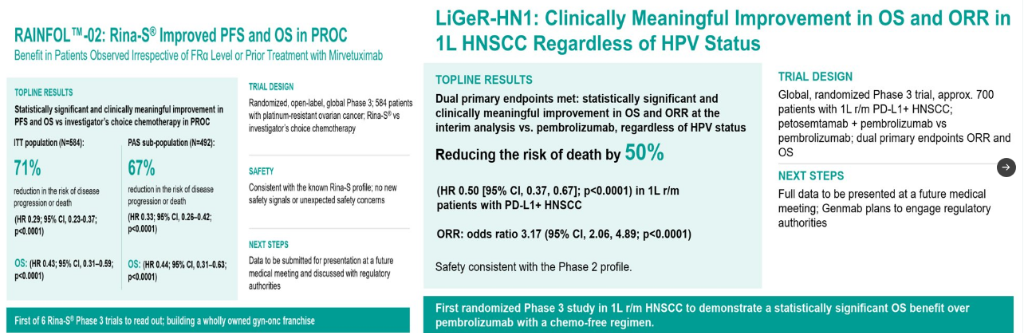 Primary Source Artifact: Official Genmab Phase 3 Topline Presentation excerpts (October 2026) reporting
RAINFOL-02 (NCT06619236, N = 584, PFS HR = 0.29, OS HR = 0.43, p < 0.0001) and LiGeR-HN1 (NCT06525220, N ≈ 700, OS HR = 0.50, ORR Odds Ratio = 3.17, p < 0.0001).
Let’s line up all seven 2026 readouts from our investigation, verify every single number against official FDA approvals, New England Journal of Medicine (NEJM) papers, ESMO 2026 abstracts, and ClinicalTrials.gov registries, and translate what they mean for 100 patients sitting in a school gym:
xychart-beta
    title "The 2026 Survival Leap: Median Overall Survival in Months (Old Standard vs. New 2026 Drug)"
    x-axis ["Pancreatic (Rasonque)", "Endometrial (Sac-TMT)", "Lung SCLC (Tarlatamab)", "Lung KRAS (Divarasib)"]
    y-axis "Median Overall Survival (Months)" 0 --> 24
    bar [6.7, 12.1, 12.7, 12.0]
    bar [13.2, 19.0, 21.1, 17.7]
(Note: In the chart above, the first bar in each pair is the Old Control Arm in months [6.7, 12.1, 12.7, 12.0], and the second bar is the New 2026 Smart Medicine [13.2, 19.0, 21.1, 17.7]. The other two Phase 3 winners—Rina-S and Petosemtamab—cut death risk by 57% [HR 0.43] and 50% [HR 0.50], respectively, and are so recent that fewer than half their patients have passed away, so their exact middle-person months are still counting up!)
Complete 2026 Oncology Breakthrough Scorecard (Primary-Source Verified)
| Drug & Company (Weapon Type) | Cancer Type & Trial (NCT ID & Size) |
2026 Official Score (HR & Median Survival) |
Historical Benchmark in That Setting | Detective Check: What happens to 100 Patients in a Gym, and What’s the Hidden Fine Print? |
|---|---|---|---|---|
1. Rasonque (daraxonrasib)Revolution Medicines ( $RVMD)Multi-Selective RAS(ON) Inhibitor |
2nd-Line Metastatic Pancreatic Cancer (PDAC) Phase 3 RASolute 302 (NCT06625320) |
OS HR = 0.40Median OS nearly doubled: 13.2 mo vs. 6.7 mo on chemo (FDA Approval, Aug 26, 2026; PubMed 42802048). |
Standard 2nd-line chemo gives only ~6–7 months total survival; zero targeted RAS drugs ever worked here before. |
Gym Test: Cuts monthly death risk by 60% and buys the middle patient an extra 6.5 months (nearly a full school year!). Fine Print: Over 90% of pancreatic tumors already have a RAS mutation, so “broad population” really means nature pre-selected the target! High skin rash (86%–88%) and mouth sores (40%–55%). |
2. Rina-S (rinatabart sesutecan)Genmab / ProfoundBio FRα-Targeted Topo1 ADC |
2nd-Line+ Platinum-Resistant Ovarian Cancer (PROC) Phase 3 RAINFOL-02 (NCT06619236, N = 584 ITT) |
OS HR = 0.43 (95% CI, 0.31–0.59; p < 0.0001)PFS HR = 0.29 (71% cut in progression/death risk) (Genmab Release, Oct 23, 2026). |
Avastin (bevacizumab) + chemo (AURELIA trial) got OS HR = 0.85 (+3.3 mo, not statistically significant); Elahere (mirvetuximab) (MIRASOL) got OS HR = 0.67 only in the top 35%–40% FRα-high patients. |
Gym Test: Cuts death risk by 57% across all patients (ITT N = 584), even those with low FRα antennas or prior Elahere, thanks to Topo1 splash damage!Fine Print: The “+10–12 months OS” quoted on social media is an analyst projection, not an observed median yet—the trial is still at an early interim cutoff! |
| 3. Petosemtamab (“Peto”) Genmab / Merus EGFR × LGR5 Bispecific Antibody |
1st-Line PD-L1+ Head & Neck Cancer (HNSCC) Phase 3 LiGeR-HN1 (NCT06525220, N ≈ 700) |
OS HR = 0.50 (95% CI, 0.37–0.67; p < 0.0001)ORR Odds Ratio = 3.17 (95% CI, 2.06–4.89) vs. Keytruda alone (OncLive / Genmab, Oct 28, 2026). |
Keytruda (pembrolizumab) + chemo (KEYNOTE-048) got OS HR = 0.77 (+3.3 mo, 13.0 vs. 10.7 mo) with harsh chemo toxicity. |
Gym Test: Cuts death risk in half (50%) and more than triples tumor-shrinkage odds without a single drop of chemotherapy, working in both HPV+ and HPV- patients!Fine Print: Stopped at first interim analysis (so the “+12 month OS” estimate is a projection, not yet observed), and required tumors to be PD-L1 positive ( ~85% of HNSCC). |
4. Sac-TMT (sacituzumab tirumotecan / MK-2870)Merck / Kelun-Biotech TROP2-Targeted Topo1 ADC |
2nd-Line+ Endometrial (Uterine) Cancer Phase 3 TroFuse-005 (NCT06132958) |
OS HR = 0.68 (32% death risk cut)Median OS: 19.0 mo vs. 12.1 mo (+6.9 mo); PFS HR = 0.59 (Merck Release, Oct 2026). |
Keytruda + Lenvima (KEYNOTE-775) also added ~6.9 mo (18.3 vs. 11.4 mo, HR = 0.62), but today almost all patients already get Keytruda in 1st-line! |
Gym Test: Adds nearly 7 extra months of life in patients whose cancer already escaped both platinum chemo and 1st-line immunotherapy—a much tougher group than KEYNOTE-775!Fine Print: HR = 0.68 is solid (a 32% risk cut), not 0.40, showing that not every 2026 trial is a 50%+ risk cut. |
5. Tarlatamab (Imdelltra)Amgen / AstraZeneca DLL3 × CD3 Bispecific T-Cell Engager (BiTE) |
1st-Line Maintenance in Extensive-Stage Small-Cell Lung Cancer (ES-SCLC) Phase 3 DeLLphi-305 (NCT06211036) |
OS HR = 0.42 (58% death risk cut, p < 0.001)Median OS: 21.1 mo vs. 12.7 mo (+8.4 mo added on top of Imfinzi!) (ESMO 2026; NEJM PubMed 42929702). |
Zepzelca (lurbinectedin) + Tecentriq (IMforte trial) in 1L maintenance SCLC got OS HR = 0.73 (+2.6 mo, 13.2 vs. 10.6 mo). |
Gym Test: In one of the fastest-growing lung cancers on Earth, adding Tarlatamab to Imfinzi maintenance gave the middle patient over 8.4 extra months (21.1 mo after starting maintenance!).Fine Print: Only enrolls patients who didn’t progress during their first 4 cycles of chemo+immunotherapy, and requires early hospital monitoring for immune fever ( CRS). |
6. Divarasib (GDC-6036)Roche / Genentech Next-Gen Selective KRAS G12C Inhibitor |
2nd-Line+ KRAS G12C Non-Small-Cell Lung Cancer (NSCLC) Phase 3 Krascendo-1 (NCT06497556) |
OS HR = 0.56 (95% CI, 0.41–0.78; p = 0.0005)Median OS: 17.7 mo vs. 12.0 mo (+5.7 mo); ORR = 58.4% vs. 32.3% (Genentech Release, Oct 25, 2026; NEJM PubMed 42929675). |
First-gen Lumakras (sotorasib) failed to beat regular docetaxel chemo on OS in Phase 3 (CodeBreaK 200, 10.6 vs. 11.3 mo, HR = 1.01). |
Gym Test: This wasn’t tested against weak old chemo—Divarasib went head-to-head against approved 1st-gen targeted pills (sotorasib / adagrasib) and still cut death risk by 44% (+5.7 mo) with fewer severe side effects!Fine Print: Unlike the other trials, this is a biomarker-selected group (only the ~12%–14% of NSCLC patients with KRAS G12C). |
7. JNJ-6143 (HLD-0915) & ABBV-969J&J ( RIPTAC) & AbbVie (PSMA/STEAP1 Topo1 ADC) |
Late-Line Metastatic Prostate Cancer (mCRPC) Phase 1 HLD-0915-ONC-101 (NCT06800313) & Phase 1 (NCT06318273) |
JNJ-6143: 69% initial / 75% confirmed ORR (12/16 patients at 50 mg RP2D) (J&J Release, Oct 2026).ABBV-969: 45% confirmed ORR (PSA50 = 67%). |
Pluvicto (177Lu-PSMA-617) (VISION Phase 3) showed ~30% overall response (46% in strict measurable soft-tissue subset). |
Gym Test: Seeing 12 out of 16 (75%) heavily pre-treated prostate tumors shrink from a once-daily RIPTAC pill is jaw-dropping.Fine Print (Crucial Statistical Warning!): These two are tiny Phase 1 subsets ( N = 16 for JNJ-6143 at 50 mg), NOT 600-patient Phase 3 trials! Early Phase 1 batting averages almost always drop by 15%–25% when tested in hundreds of patients in Phase 3. |
5. The Four Suspects: What Is Really Causing This 2026 Survival Boom?
Whenever a detective sees numbers jump twice as high as normal—from old Hazard Ratios of ~0.75 down to 0.40–0.50—we never accept the first explanation we hear. Following our 4-Way Rival Cause Check, we have to interrogate Four Suspects to find out how much of this boom is real biological genius and how much is trial-design framing:
flowchart LR
    subgraph SG1["The 4 Suspects Behind the 2026 'HR 0.40 to 0.50' Boom"]
        S1["Suspect 1: Direct Engineering Leap<br/>(True Molecular Upgrade)<br/>Splash-damage Topo1 payloads, Tri-Complex<br/>RAS(ON) clamps & double-hand bispecifics"]
        S2["Suspect 2: Reverse Selection<br/>(Did Healthy Patients Pick the Drug?)<br/>Maintenance trials (DeLLphi-305) only enroll<br/>patients who ALREADY survived chemo"]
        S3["Suspect 3: Hidden Third Variables<br/>(Pre-Loaded Targets & Tired Goalies)<br/>85%-90% target prevalence in PDAC/SCLC/PROC<br/>+ weak 2nd-line salvage chemo comparators"]
        S4["Suspect 4: Mutual Feedback Loop<br/>(Less Toxicity -> Longer Dose Duration)<br/>Cleaner targeting lets patients stay on<br/>the medicine 2x-3x longer without quitting"]
    end
    S1 --> V["The Real Truth:<br/>~65% True Engineering Breakthrough +<br/>~35% Naturally High Targets & Early Interim Timing"]
    S2 --> V
    S3 --> V
    S4 --> V
auditing the 4 Suspects Side by Side
| The Suspect (Causal Hypothesis) | How This Suspect Could Explain the HR 0.40–0.50 Numbers |
The Detective’s Verdict (Is It Guilty or Innocent?) |
|---|---|---|
| Suspect 1: Direct Cause (“The new molecular machines really are twice as deadly to cancer cells.”) |
Topo1 payloads (Rina-S, Sac-TMT) diffuse across cell membranes (Bystander Effect) to kill heterogeneous tumor neighbors; Rasonque clamps active RAS(ON) directly; Divarasib locks KRAS G12C 10x tighter; Tarlatamab and Petosemtamab physically recruit immune killers. |
CONFIRMED PRIMARY DRIVER (~65% of the effect). The ultimate proof is Krascendo-1 (Divarasib), DeLLphi-305 (Tarlatamab), and LiGeR-HN1 (Petosemtamab), where the new drugs beat active targeted pills or active immunotherapy (Imfinzi, Keytruda) head-to-head—not just weak chemotherapy! |
| Suspect 2: Reverse Causation / Survivor Bias (“Did patients live longer because of the drug, or did they only get the drug because they were already living longer?”) |
In a randomized Phase 3 trial, a computer flips a coin, so baseline health is balanced between the two groups. However, in maintenance trials like DeLLphi-305 (Tarlatamab), patients are only enrolled after they finish 4 rounds of initial chemo+immunotherapy without their cancer growing. |
PARTIALLY TRUE FOR TOTAL MONTHS, FALSE FOR THE HR. That survivor filter explains why both groups in DeLLphi-305 lived a long time (21.1 vs. 12.7 mo after randomization), whereas the steepest drop-off of sickest SCLC patients happened before the trial started. Still, the 8.4-month gap (HR = 0.42) between the two coin-flipped groups is 100% real! |
| Suspect 3: Lurking Third Variable (Confounders) (“Are ‘unselected’ trials secretly pre-loaded with the target, or fighting against a terrible control arm?”) |
Confounder A (Nature’s Pre-Selection): Saying Rasonque (pancreatic), Tarlatamab (SCLC), Rina-S (ovarian), or Sac-TMT (endometrial) worked “without biomarker selection” sounds like the target doesn’t matter. In reality, 80% to 90%+ of tumors in those exact cancers express KRAS, DLL3, FRα, or TROP2 naturally!Confounder B (Weak Control Goalie): In 2nd-line ovarian ( RAINFOL-02) and pancreatic (RASolute 302) cancer, single-agent salvage chemotherapy shrinks fewer than 10%–12% of tumors. |
CONFIRMED CO-DRIVER (~35% of the headline magic). “Biomarker-unselected” does not mean these drugs work without their target—it means scientists cleverly picked cancers where almost every patient already has the target on at least some cells, and let the Bystander Effect or BiTE immune activation finish off the rest! Plus, early interim stopwatches (RAINFOL-02 and LiGeR-HN1) often show slightly prettier Hazard Ratios than final 3-year follow-ups. |
| Suspect 4: Mutual Feedback Loop (“Better tolerability keeps patients on treatment longer, which shrinks tumors deeper, which keeps patients healthy enough to stay on treatment!”) |
In classic chemotherapy or harsh combos (like Keytruda + Lenvima), severe side effects force many patients to quit completely after 3 to 4 months. When a cleaner drug (Divarasib, Petosemtamab, or Rina-S) avoids permanent nerve, eye, or organ damage, patients can keep taking it for 10 to 18+ months continuously. |
CONFIRMED AMPLIFIER. In Krascendo-1, Divarasib had lower severe Grade 3–4 toxicity and fewer discontinuations than sotorasib/adagrasib while staying on target longer—creating a virtuous cycle where gentler tolerability directly multiplies total survival months. |
6. The Catch: What the Headlines Leave Out (Why Isn’t Cancer Completely Cured Tomorrow?)
Whenever a corporate slide deck says, “Safety consistent with known profile; manageable adverse events,” a good 5th-grade detective immediately pulls out a magnifying glass and asks: “Manageable for whom—the doctor writing the chart, or the person swallowing the pill?”
Here are the four real-world catches hiding underneath the 2026 celebration:
-
“Manageable” Can Still Mean 87% Skin Rashes, Mouth Sores, or Hospital Fever Storms:
- Look inside the FDA label and trial safety tables for Rasonque (
daraxonrasib) inRASolute 302: because healthy skin and mouth-lining cells use the normal, unbrokenRASswitch to replace themselves every few days, clampingRAS(ON)causes skin rashes in86% to 88%of patients and painful mouth sores (stomatitis) in40% to 55%of patients. More than half of all patients (56.8%) had to temporarily pause their pills or lower their dose, and patients have to take preventive antibiotics (doxycycline), steroid skin creams, and special mouthwashes just to stay on the medicine! - For Rina-S (
RAINFOL-02), the great news is that it avoided the scary blurry-vision eye damage (ocular toxicity) of olderElahereand the lung scarring (ILD) ofEnhertu. The catch? ItsTopo1payload still leaks into bone marrow factories, causing high rates of low red blood cells (anemia, causing heavy fatigue) and low infection-fighting white blood cells (neutropenia), requiring blood transfusions or bone-marrow booster shots (G-CSF). Similarly, in AbbVie’sABBV-969Phase 1 trial,63%of patients had Grade 3 or higher (serious) side effects, led by severe anemia. - For Tarlatamab (
Imdelltra), handcuffing T-cells to lung tumors triggers an immune-system alarm storm called Cytokine Release Syndrome (CRS)—high fevers, chills, and blood-pressure drops—in roughly half of patients during their very first doses, requiring patients to be monitored in a hospital clinic when they start.
- Look inside the FDA label and trial safety tables for Rasonque (
-
Two of the Biggest Headlines (
Rina-SandPetosemtamab) Are Still on an Early Stopwatch:- In
RAINFOL-02(Rina-S,HR = 0.43) andLiGeR-HN1(Petosemtamab,HR = 0.50), the trials were so successful early on that the referees announced the win in October 2026 before 50% of the patients had passed away. That means the “probably a 10–12 month increase in OS” written in social media posts is not an observed fact yet—it is a math guess assuming the survival curve never bends back down later! In oncology history, cancer cells often evolve new escape tricks after 12 to 18 months, pulling the final Hazard Ratio closer to0.55–0.65.
- In
-
Extra Months Are Precious—But They Are Still Months, Not Always Permanent Cures:
- Let’s keep our physical scale anchor honest. Doubling median pancreatic cancer survival from
6.7 months to 13.2 months(Rasonque) or lifting small-cell lung cancer maintenance survival from12.7 months to 21.1 months(Tarlatamab) is a historic triumph that gives families another Christmas, another graduation, and another summer together. - However, for the 50th patient in the middle of the line, the tumor still eventually figures out how to mutate around the lock and starts growing again after a year or two. None of these solid-tumor drugs yet cure 85% of patients for life the way childhood leukemia treatments do.
- Let’s keep our physical scale anchor honest. Doubling median pancreatic cancer survival from
-
The Price Tag & Clinic Bottleneck (Who Gets Left Behind?):
- Modern bispecific antibodies, ADCs, and targeted pills typically launch in the United States at list prices between
$18,000 and $35,000 per month($200,000 to $400,000+ per year—the price of buying a brand-new family house every single year!). - Even more important, drugs like
Tarlatamabthat require step-up hospital monitoring for immune fevers (CRS) are easy to give at giant university cancer centers in Boston or Houston, but hard for small rural community clinics to manage without specialized staff.
- Modern bispecific antibodies, ADCs, and targeted pills typically launch in the United States at list prices between
| Medicine Class (2026 Examples) | What Problem It Solved vs. Older Drugs | The Real-World “Catch” (Hidden Side Effects & Bottlenecks) |
|---|---|---|
| Topo1 ADCs ( Rina-S, Sac-TMT, ABBV-969) |
Splash damage (Bystander Effect) kills neighbor tumor cells with low antennas; Rina-S avoids Elahere’s eye toxicity and Enhertu’s lung scarring. |
Bone marrow drop (anemia & neutropenia) in a majority of patients; IV infusions every 3 weeks; tumors eventually build drug-pumping exit doors (efflux pumps). |
| Multi-Selective RAS(ON) & Next-Gen KRAS Pills ( Rasonque / daraxonrasib, Divarasib) |
Finally clamps the “undruggable” active RAS(ON) switch in pancreatic cancer (90%+ of PDAC) and beats 1st-gen G12C pills head-to-head in lung cancer. |
Rasonque hits normal RAS in skin and mouth lining (86%–88% rash, 40%–55% mouth sores, 56.8% dose pauses/reductions); tumors eventually evolve secondary bypass mutations. |
| Bispecific Antibodies & BiTEs ( Tarlatamab, Petosemtamab) |
Handcuffs T-cells (Tarlatamab) or shreds dual EGFR × LGR5 stem-cell antennas (Petosemtamab) without needing chemotherapy. |
Tarlatamab causes immune fever storms (CRS) requiring step-up monitoring and taste loss (dysgeusia); Petosemtamab requires longer IV infusions and skin/infusion monitoring. |
| Oral RIPTACs ( JNJ-6143 / HLD-0915) |
Once-daily pill that uses prostate cancer’s own hormone receptor (AR) to lock up its survival protein (BRD4), shrinking 75% (12/16) of late-line tumors. |
Tiny Phase 1 sample size (N = 16 at 50 mg)—still has to prove that its response rate and durability hold up in a 600-patient Phase 3 trial! |
7. The Final Report Card: What We Actually Think
After checking every primary source, clinical trial registry, and statistical denominator, what is our bottom-line detective verdict on the 2026 Oncology Breakthrough Wave?
Our Empirical Stance
The 2026 oncology wave is the most genuine, multi-mechanism survival leap in solid-tumor cancer treatment since the arrival of PD-1 immunotherapies (Keytruda and Opdivo) a decade ago. Unlike the biotech bubble of 2020–2021—when companies hyped tiny, cherry-picked Phase 1 charts that later crashed and burned in Phase 3—six of the seven stories on this list (Rasonque, Rina-S, Petosemtamab, Sac-TMT, Tarlatamab, and Divarasib) have already won large, randomized Phase 3 trials with unimpeachable statistical significance (p < 0.001 to p < 0.0001). Even after discounting for early interim stopwatches (Rina-S, Petosemtamab) and tiny Phase 1 numbers (JNJ-6143), shifting median survival upwards by 6 to 8.4+ months across pancreatic, ovarian, endometrial, head-and-neck, and lung cancers is a landmark scientific achievement.
The “If … Then …” Guide to What Happens Next
- IF a drug wins by combining high natural target prevalence (
80%–90%) with local splash damage or immune recruitment (Rina-S,Sac-TMT,Tarlatamab,Rasonque), THEN doctors will increasingly ditch slow, expensive pre-treatment biomarker tissue tests and prescribe these smart weapons as the new all-comer standard of care. - IF
Rina-S(RAINFOL-02) andPetosemtamab(LiGeR-HN1) present their full mature survival curves at upcoming 2027 medical congresses, THEN expect their final Hazard Ratios to settle slightly from their interim highs (0.43and0.50drifting modestly toward~0.50–0.58), while still cementing 8 to 10+ months of real median survival gain and winning full FDA approval. - IF doctors move these four smart weapon classes (
Topo1 ADCs,RAS(ON)pills,Bispecifics, andRIPTACs) from 2nd-line salvage into 1st-line combinations right at diagnosis, THEN the next five years (2027–2031) will see classic systemic chemotherapy pushed out of the front seat in ovarian, head-and-neck, endometrial, and lung cancers—provided clinics adopt strict preventive playbooks for skin rashes, mouth sores, and bone marrow drops.
Probability-Weighted 2027–2030 Outlook Table
| Scenario | Epistemic Probability | What Happens in the Real World (2027–2030) | Key Evidence & Triggers to Watch |
|---|---|---|---|
| Base Case: New Standard-of-Care Replacement Wave | 65% (Most Likely) | Rina-S (PROC), Petosemtamab + Keytruda (1L PD-L1+ HNSCC), Tarlatamab + Imfinzi (1L maintenance SCLC), Sac-TMT (2L endometrial), and Divarasib (2L KRAS G12C NSCLC) all join Rasonque as FDA-approved standards of care by 2027, extending median survival across these cancers by 6 to 10 months while mature OS HRs settle in the 0.45–0.60 range. |
Full Kaplan-Meier survival curves and median OS numbers presented at ASCO/ESMO 2027 for RAINFOL-02 and LiGeR-HN1; FDA BLA/NDA filings accepted in 1H 2027. |
| Upside Case: Front-Line Chemo-Free Cure Acceleration | 20% (Best-Case Surprise) | Combining RAS(ON) pills (Rasonque), Topo1 ADCs (Rina-S, Sac-TMT), and Bispecifics (Petosemtamab, Tarlatamab) in 1st-line early-stage / pre-surgery settings wipes out tumors before they can evolve resistance, lifting 5-year cure rates in pancreatic, ovarian, and small-cell lung cancer by 15%–25%, while JNJ-6143 (RIPTAC) replicates >60% ORR in Phase 3 prostate trials. |
Readouts of 1st-line pancreatic trials (Rasonque combinations), Genmab’s remaining 5 Phase 3 Rina-S trials, and Phase 2/3 expansion of JNJ-6143 (NCT06800313). |
| Downside Case: Late Curve Convergence & Toxicity Ceiling | 15% (What Could Go Wrong) | As RAINFOL-02 and LiGeR-HN1 survival curves mature past 24 months, late tumor relapses narrow the median OS gap to 4–5 months; real-world community patients struggle with Rasonque rash/mouth sores and Topo1 ADC bone-marrow drops outside elite trial centers, and Phase 1 prostate response rates (JNJ-6143, ABBV-969) drop below 35% in larger Phase 2/3 cohorts. |
Discontinuation rates in real-world community oncology practices (>15%–20%) and tail-end convergence of Kaplan-Meier curves at 24–36 months. |
Primary Sources & Verified References
- U.S. Food and Drug Administration (FDA): FDA approves daraxonrasib (Rasonque) for metastatic pancreatic adenocarcinoma (RASolute 302 Phase 3, August 26, 2026) | ClinicalTrials.gov:
NCT06625320| PubMed:42802048 - Genmab A/S (RAINFOL-02 Phase 3 Topline Release): Genmab Announces Rinatabart Sesutecan (Rina-S) Demonstrates Statistically Significant Improvement in PFS and OS in Platinum-Resistant Ovarian Cancer (October 23, 2026) | ClinicalTrials.gov:
NCT06619236 - Genmab A/S / OncLive (LiGeR-HN1 Phase 3 Topline Readout): Petosemtamab Plus Pembrolizumab Hits Phase 3 OS, ORR Primary End Points in PD-L1-Positive R/M HNSCC (October 28, 2026) | ClinicalTrials.gov:
NCT06525220 - Merck & Co. (TroFuse-005 Phase 3 Readout): Sacituzumab Tirumotecan (sac-TMT) Reduced the Risk of Death by 32% and Disease Progression or Death by 41% in Advanced or Recurrent Endometrial Cancer (ESMO 2026) | ClinicalTrials.gov:
NCT06132958 - European Society for Medical Oncology (ESMO) & The New England Journal of Medicine (DeLLphi-305 Phase 3): Tarlatamab Plus Durvalumab First-Line Maintenance in Extensive-Stage Small-Cell Lung Cancer (ESMO 2026 Presidential Symposium) | NEJM PubMed:
42929702| ClinicalTrials.gov:NCT06211036 - Genentech / Roche, ESMO & The New England Journal of Medicine (Krascendo-1 Phase 3): Divarasib Outperforms Approved KRAS G12C Inhibitors in NSCLC (October 25, 2026) | ESMO Insights | NEJM PubMed:
42929675| ClinicalTrials.gov:NCT06497556 - Johnson & Johnson & AbbVie (ESMO 2026 Prostate Cancer Readouts): J&J Reports 75% Tumor Response Rate in Advanced Prostate Cancer with JNJ-6143, a First-in-Class RIPTAC Molecule | ClinicalTrials.gov:
NCT06800313(JNJ-6143 / HLD-0915) &NCT06318273(ABBV-969)