A reader asked a direct, searching, and completely understandable question:
“A few years ago, people were going completely bonkers saying mRNA would just change everything—that biology was now ‘software’ and we’d compile cures overnight. Is that still true? What killed the excitement? What are the roadblocks and limitations? What went wrong, is mRNA still salvageable, and is there a path forward? This isn’t my expertise, so please give me a fair, unvarnished evaluation.”
It is the defining question in biopharma right now. And just days ago, in October 2026, the question roared back into the headlines:
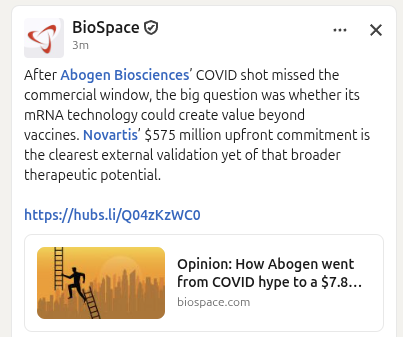 Source: BioSpace reporting on Novartis’s $575 million upfront, $7.8 billion total commitment to Abogen Biosciences for an in vivo mRNA T-cell engager (October 2026).
On paper, this looks like complete whiplash:
- Between 2022 and 2025, public enthusiasm for mRNA cratered. Moderna’s market capitalization collapsed by over 80% from its 2021 peak. BioNTech pivoted billions into traditional Antibody-Drug Conjugates (ADCs). In May 2026, Vertex and Moderna scrapped their long-awaited inhaled cystic fibrosis program due to lung toxicity. CureVac laid off 30% of its workforce and sold off vaccine rights to GSK.
- And yet, in October 2026, Novartis cuts a $575 million upfront check—part of a $7.8 billion deal—for an experimental mRNA therapy. AbbVie recently bought Capstan Therapeutics for in vivo CAR-T. Merck and Moderna have demonstrated a 49% reduction in melanoma recurrence or death with personalized neoantigen vaccines.
So what actually happened? Did mRNA fail? Was the original excitement a fraud? Or did we simply confuse the mechanics of a miraculous vaccine with the brutal biophysical reality of treating chronic human disease?
Here is the objective, science-based breakdown of why the “software” metaphor broke down, the five physical bottlenecks that caused the hangover, and why mRNA is now entering its most realistic and consequential era.
Part 1: The “Software for Life” Fallacy — Why the Bubble Popped
To understand what went wrong, you have to revisit the euphoria of 2020–2021.
When the first COVID-19 vaccines rolled off manufacturing lines with ~95% efficacy just 11 months after the SARS-CoV-2 genetic sequence was posted online, Silicon Valley and Wall Street declared biology “solved.”
Moderna’s corporate deck literally branded mRNA as an “Operating System” (the OS of Life). The pitch was seductive to software-minded venture capitalists:
- DNA is source code stored on disk.
- mRNA is the ephemeral binary instruction set sent to ribosomes.
- Proteins are the compiled applications.
- If you want a new medicine, don’t waste 10 years screening millions of chemical compounds in test tubes. Just edit the nucleotide text file (A, U, C, G), encapsulate it, hit run, and the patient’s cells compile the drug on demand.
At its peak in August 2021, Moderna’s market capitalization touched $195 billion—worth more than century-old pharmaceutical giants like Bristol Myers Squibb or Amgen—despite selling exactly one commercial product.
The immediate prediction was that mRNA would rapidly sweep across every corner of medicine: seasonal flu, RSV, cytomegalovirus (CMV), Epstein-Barr, HIV, cancer, heart failure, and rare genetic enzyme deficiencies.
       The Silicon Valley Biological Compiler Fallacy (2021)
       ┌─────────────────┐       ┌─────────────────┐       ┌─────────────────┐
       │   Digital Code  │ ───>  │  LNP Injection  │ ───>  │ Universal Cure  │
       │  (A, U, C, G)   │       │  "Run Binary"   │       │ (Any Protein)   │
       └─────────────────┘       └─────────────────┘       └─────────────────┘
                                          │
                                 REALITY CHECK (2026)
                                          ▼
       ┌─────────────────────────────────────────────────────────────────────┐
       │ 1. 80-90% trapped in liver (LDLR / ApoE clearance)                 │
       │ 2. 98% destroyed in endosomes (1-2% escape efficiency)              │
       │ 3. Repeat dosing triggers neutralizing & anti-PEG antibodies        │
       │ 4. Systemic lipid reactogenicity & organ inflammation               │
       │ 5. Cold-chain instability & thermodynamic degradation               │
       └─────────────────────────────────────────────────────────────────────┘
The hangover arrived when developers tried to translate the vaccine blueprint into seasonal illnesses and chronic therapies.
1. The Seasonal Vaccine Reality Check (Flu and RSV)
For a deadly global pandemic, waking up with a 101°F fever, chills, and muscle soreness for 24 hours is a trivial price to pay for life-saving immunity.
For an annual seasonal flu shot, it is a non-starter.
When Moderna took its seasonal influenza candidate (mRNA-1010) into head-to-head clinical trials against standard-of-care seasonal vaccines (like Fluzone High-Dose), reality bit hard. Not only did the mRNA vaccine induce significantly higher rates of systemic adverse events (fever, chills, severe fatigue), but it initially struggled to demonstrate superior antibody responses against Influenza B strains. If a traditional, $25 egg- or recombinant-based shot gives you adequate protection with zero side effects, consumers and health systems will not tolerate feeling bedridden for an mRNA upgrade.
Similarly, in Respiratory Syncytial Virus (RSV), while Moderna secured approval for its mRNA-based vaccine (mRESVIA), clinical data demonstrated that its protective efficacy waned more steeply over successive seasons compared to traditional protein subunit vaccines from GSK (Arexvy) and Pfizer (Abrysvo)—which also do not require specialized frozen storage.
2. The Commercial Hangover and Pipeline Pruning
As COVID infection fatality dropped and booster fatigue set in globally, vaccine revenues dropped off a cliff. Moderna’s revenue tumbled from $18.4 billion in 2022 to under $3.5 billion in 2024.
At its Annual R&D Day in September 2024, Moderna was forced to announce a dramatic retrenchment: slashing $1.1 billion in annual R&D spending by 2027 and outright discontinuing five clinical programs, including its KRAS cancer vaccine (mRNA-5671), its relaxin cardiovascular program (mRNA-0184), and an infant RSV program.
BioNTech, meanwhile, sat on nearly €17 billion in pandemic cash reserves and came to an equally sober conclusion: mRNA was not going to solve solid tumors alone. BioNTech systematically redeployed billions of dollars into acquiring and licensing Antibody-Drug Conjugates (ADCs)—such as its $1.5B+ deal with Shanghai’s DualityBio—and conventional targeted bispecific antibodies.
Part 2: The Core Scientific Problem — Vaccines vs. Therapeutics
Why did mRNA conquer COVID in 300 days, but fail for years to replace a single missing enzyme in a rare disease?
The answer lies in a fundamental biological dichotomy that public discourse ignored: The physics of a vaccine are the polar opposite of the physics of a therapeutic.
| Parameter | Vaccines (Where mRNA Thrives) | Therapeutics / Protein Replacement (Where mRNA Stalls) |
|---|---|---|
| Required Dose | Micrograms ($\approx 10 - 100\ \mu\text{g}$) | Milligrams ($\approx 10 - 500\ \text{mg}$, 100x to 1,000x higher) |
| Expression Duration | Transient (2 to 4 days is optimal) | Sustained / Chronic (Weeks, months, or lifelong) |
| Dosing Frequency | 1 to 3 times per lifetime or year | Weekly, bi-weekly, or monthly repeat infusions |
| Role of Immunogenicity | Feature: Innate immune activation acts as an adjuvant | Fatal Bug: Triggers neutralizing antibodies & systemic toxicity |
| Primary Target Tissue | Local muscle tissue & draining lymph nodes | Deep systemic organs (Lungs, heart, brain, bone marrow) |
| Clinical Margin | Huge: Minimal protein produces massive immune memory | Razor-thin: Missing enzyme must reach precise physiological levels |
The Immunogenicity Double-Edged Sword
In a vaccine, you do not need much protein. A microscopic whisper of viral spike protein produced inside your deltoid muscle for 48 hours is more than enough.
Crucially, immunogenicity is your friend in a vaccine. When Katalin Karikó and Drew Weissman won the 2023 Nobel Prize in Physiology or Medicine for discovering that substituting uridine with pseudouridine ($\Psi$) dampened runaway inflammatory responses (Karikó et al., Immunity 2005), they made mRNA translatable. But mRNA and its lipid carriers are never completely silent. The residual activation of innate sensors (Toll-like receptors TLR7/8, MDA5) acts as an endogenous adjuvant. It screams “foreign pathogen!” to dendritic cells, driving a ferocious antibody and T-cell response.
In a therapeutic (such as replacing the CFTR channel in cystic fibrosis or phenylalanine hydroxylase in PKU), that exact same biological response is catastrophic:
- Accelerated Blood Clearance (ABC): When you infuse lipid nanoparticles repeatedly, the immune system generates anti-PEG and anti-lipid antibodies. By the second or third dose, macrophage scavenger cells in the spleen clear the nanoparticles before they ever deliver their cargo.
- Neutralizing Antibodies to the Drug: If the patient’s body has never seen the missing wild-type enzyme, their immune system recognizes the newly translated protein as foreign and produces neutralizing antibodies against it.
- Chronic Toxicity: You cannot induce a mild cytokine storm every two weeks in a patient already suffering from chronic organ failure.
The tragedy of the “software” narrative was treating protein replacement as an identical problem to vaccination. It wasn’t.
Part 3: The Three Physical Roadblocks Wet Labs Couldn’t Hack
Beyond the vaccine-versus-therapeutic split, mRNA faces three brutal physical and physiological roadblocks that computational code cannot bypass.
1. The LNP “Liver Trap” (Biodistribution Bottleneck)
The delivery vehicle of choice for mRNA is the Lipid Nanoparticle (LNP)—a microscopic bubble composed of four chemical ingredients: an ionizable cationic lipid, a helper phospholipid (DSPC), cholesterol, and a PEGylated lipid (Hou et al., Nat Rev Mater 2021).
When you inject conventional LNPs into a human bloodstream, they do not circulate freely like software packets on the internet. Within seconds, blood proteins adhere to the particle’s surface.
Specifically, the particles become coated with Apolipoprotein E (ApoE). ApoE’s biological job is to chaperone dietary fats directly to low-density lipoprotein receptors (LDLR) on hepatocytes in the liver.
    Intravenous Injection
           │
           ▼
    [ LNP Formulation ] ──> Blood Plasma ──> ApoE Protein Opsonization
                                                      │
                                                      ▼
                                       Binds LDLR on Hepatocytes
                                                      │
                                                      ▼
                                      ┌───────────────────────────────┐
                                      │  80% to 90%+ Cleared to LIVER │
                                      └───────────────────────────────┘
                                                      │
                    ┌─────────────────────────────────┴─────────────────────────────────┐
                    ▼                                                                   ▼
       LIVER-BASED TARGETS (SUCCESS)                                    NON-LIVER TARGETS (COLLAPSE)
       • Transthyretin Amyloidosis (ATTR)                                • Lungs (Cystic Fibrosis)
       • PCSK9 / Hypercholesterolemia                                    • Heart / Brain / Skeletal Muscle
       • Hepatic Enzyme Deficiencies                                     • Autoimmune T-cells
As reviewed by Paunovska et al. in Nature Reviews Genetics (2022), 80% to 90%+ of systemically administered LNPs accumulate in the liver.
If your therapeutic target is in the liver—as in hereditary transthyretin amyloidosis or cholesterol regulation—this is a blessing. But if your target is the heart, the lungs, the central nervous system, or skeletal muscle, your therapeutic index collapses. To get even 1% of the dose into the target organ, you must flood the patient with massive lipid doses that trigger hepatotoxicity.
This was tragically illustrated in May 2026, when Vertex Pharmaceuticals and Moderna formally terminated VX-522, their joint inhaled mRNA program for cystic fibrosis. To reach the lungs without hitting the liver, they aerosolized the LNPs for direct inhalation. But repeated exposure to the lipid carriers provoked lung inflammation in patients, forcing the trial’s termination before clinical efficacy could even be demonstrated.
2. The Endosomal Escape Tax (The 1% to 2% Bottleneck)
Even when an LNP successfully lands on the correct target cell, its journey has barely begun.
The cell engulfs the nanoparticle via receptor-mediated endocytosis, enclosing it inside an acidic membrane bubble called an endosome. To do its job, the mRNA must escape this bubble and cross into the cytoplasm where ribosomes live.
How much mRNA actually escapes?
In a landmark quantitative analysis published in Nature Biotechnology, researchers discovered that only 1% to 2% of nucleic acid cargo ever makes it out of the endosome (Gilleron et al., Nat Biotechnol 2013).
More than 98% of the mRNA is trapped, shuttled into lysosomes, and enzymatically destroyed without ever producing a single protein.
Because the intracellular engine operates at ~2% efficiency, developers are forced to inject 50 times more lipid material than theoretically required to hit therapeutic protein thresholds. That 50-fold excess of synthetic lipids is precisely what triggers toll-like receptors, complement activation, and tissue reactogenicity.
3. Thermodynamic Instability and Cold Chains
Unlike double-stranded DNA, which can survive intact in fossilized mammoth bones for millennia, single-stranded mRNA is thermodynamically fragile. Its 2’-hydroxyl group makes the phosphodiester backbone inherently susceptible to alkaline hydrolysis. Furthermore, human skin, air, and bacterial dust are saturated with RNases—hyper-stable, indestructible enzymes evolved specifically to destroy foreign RNA.
Formulating mRNA into an LNP does not freeze time; it simply slows degradation. The requirement for deep-freeze storage ($-20^\circ\text{C}$ to $-80^\circ\text{C}$) proved an enormous operational and financial barrier for non-pandemic medicines, particularly in developing economies and decentralized outpatient clinics.
Part 4: Where mRNA Actually Wins in 2026 — The Real Frontiers
If mRNA isn’t a universal compiler for chronic pills, is it dead?
Decisively, no.
Just as structural biology realized AlphaFold’s true superpower was experimental molecular replacement and de novo protein generation rather than one-shot drug discovery, biotechnology has identified four specific frontiers where mRNA’s physical quirks are not liabilities, but insurmountable advantages.
1. In Vivo T-Cell Engagers: The Abogen-Novartis Breakthrough (October 2026)
This brings us directly to the $7.8 billion headline from the reader’s prompt: Novartis’s licensing of ABO2203 from Abogen Biosciences.
Why would Novartis pay $575 million upfront for an mRNA candidate in late 2026?
Because ABO2203 uses mRNA to solve the single worst crisis in cellular immunotherapy: manufacturing and toxicity.
                     The Paradigm Shift in Cellular Medicine

   CONVENTIONAL EX VIVO CAR-T                        IN VIVO mRNA CELL ENGAGER (ABO2203)
   ┌────────────────────────────────┐                ┌────────────────────────────────┐
   │ 1. Harvest patient T-cells     │                │ 1. Off-the-shelf LNP injection │
   │ 2. Ship to GMP viral facility  │                │ 2. Patient cells express       │
   │ 3. 4-6 week wait ($400,000+)   │       VS.      │    CD19xCD3 bispecific in vivo │
   │ 4. Toxic lymphodepletion chemo │                │ 3. Transient B-cell depletion  │
   │ 5. High risk of lethal CRS/ICANS│               │ 4. Zero CRS reported in clinic │
   └────────────────────────────────┘                └────────────────────────────────┘
Traditionally, treating severe autoimmune diseases (like systemic lupus erythematosus or refractory rheumatoid arthritis) with B-cell depletion required:
- Ex vivo CAR-T: Taking a patient’s T-cells out of their body, modifying them with lentivirus in a cleanroom for a month, administering toxic lymphodepleting chemotherapy, and infusing them back at a cost of $400,000 to $500,000 per patient.
- Recombinant Bispecifics (TCEs): Infusing synthetic protein antibodies that latch onto CD19 on B-cells and CD3 on T-cells. Because these are long-lived proteins, they frequently provoke uncontrolled, life-threatening Cytokine Release Syndrome (CRS).
Abogen’s ABO2203 completely upends this. It delivers an mRNA sequence encapsulated in an LNP that instructs the patient’s own tissues to synthesize and secrete the CD19xCD3 T-cell engager in vivo.
Why does mRNA excel here?
- Transient, Tunable Dynamics: Because mRNA degrades naturally, the T-cell engager is expressed for a finite, predictable window. It wipes out the pathogenic B-cells—“resetting” the immune system—and then switches off.
- Superior Tolerability: In early human clinical trials presented in 2026 for lymphoma and immune thrombocytopenia (ITP), ABO2203 achieved profound B-cell depletion without a single reported case of severe Cytokine Release Syndrome.
- Off-the-Shelf Scalability: No cleanrooms, no four-week manufacturing delays, no viral vectors. Just a vial from the pharmacy shelf.
This is the exact same logic that drove AbbVie to acquire Capstan Therapeutics in August 2025. Capstan’s lead asset, CPTX2309, currently in Phase 1 trials (NCT06917742), uses targeted LNPs (tLNPs) to deliver anti-CD19 CAR mRNA directly into CD8+ T-cells inside the body, generating transient CAR-T cells in vivo without chemotherapy (Rurik et al., Science 2022).
2. Personalized Cancer Vaccines (PCVs): The Neoantigen Triumph
In oncology, mRNA is demonstrating its most rigorous clinical efficacy to date through individualized neoantigen therapy.
Every patient’s tumor has a unique, chaotic set of DNA mutations. Some of these mutations generate mutated peptides called neoantigens that the immune system can recognize. But because no two patients share the same mutational landscape, you cannot manufacture an “off-the-shelf” recombinant protein vaccine.
Synthesizing 34 bespoke recombinant proteins for one human being would take 9 to 12 months and cost millions. By the time it was ready, the patient would be dead.
mRNA turns that timeline into weeks.
In the randomized Phase 2b KEYNOTE-942 trial led by Merck and Moderna, patients with resected high-risk Stage III/IV melanoma were treated with either Merck’s checkpoint inhibitor Keytruda alone, or Keytruda combined with mRNA-4157 (V940)—an individualized mRNA vaccine encoding up to 34 patient-specific neoantigens (Weber et al., Lancet 2024).
The results:
- 3-Year Follow-up (Presented at ASCO): The addition of mRNA-4157 demonstrated a 49% reduction in the risk of recurrence or death (Hazard Ratio = 0.510) compared to Keytruda alone.
- Distant Metastasis: It slashed the risk of distant metastasis or death by over 60% (HR = 0.384).
- The 2.5-year recurrence-free survival rate stood at 74.8% for the mRNA combination versus 55.6% for checkpoint monotherapy.
Simultaneously, BioNTech and Genentech’s autogene cevumeran (BNT122) showed in Nature that in surgically resected pancreatic ductal adenocarcinoma (PDAC)—one of the deadliest cancers on Earth—patients who mounted neoantigen-specific T-cell responses to the mRNA vaccine experienced dramatically prolonged recurrence-free survival sustained through three years of follow-up (Rojas et al., Nature 2023).
Here, mRNA’s agility is irreplaceable: biopsy $\rightarrow$ sequence $\rightarrow$ predict neoantigens with AI $\rightarrow$ print mRNA $\rightarrow$ inject within weeks.
3. In Vivo CRISPR/Cas Gene Editing: The “Hit-and-Run” Advantage
In gene editing, having your therapeutic protein stick around forever is not an advantage; it is a catastrophe.
If you deliver Cas9 endonuclease via an adeno-associated virus (AAV), the viral DNA persists in the nucleus. The cell expresses Cas9 for years. Over time, that continuous enzymatic activity leads to off-target genomic cuts, chromosomal translocations, and eventual immune destruction of the edited cells by cytotoxic T-cells.
mRNA is the gold standard for in vivo CRISPR because it is a “hit-and-run” weapon.
In Intellia Therapeutics and Regeneron’s Phase 3 MAGNITUDE trial for transthyretin (ATTR) amyloidosis, their therapeutic candidate NTLA-2001 (nex-z) delivers Cas9-encoding mRNA and a guide RNA inside an LNP (Gillmore et al., N Engl J Med 2021).
- The LNP travels straight to the liver (taking advantage of natural ApoE tropism).
- Hepatocytes absorb the particle; ribosomes translate Cas9 protein.
- Cas9 and sgRNA find the target TTR gene, make a single precision double-strand break to deactivate the gene, and within 24 to 48 hours, the mRNA and Cas9 protein degrade completely.
- The misfolded protein is knocked down by >90% for life after a single, one-time infusion.
Because you want the protein to disappear after doing its job, mRNA is intrinsically superior to any viral vector or recombinant enzyme.
4. Next-Gen Engineering: Escaping the Liver
The biophysical limitations of 2021 are actively being solved by chemical biology:
- Selective Organ Targeting (SORT lipids): Pioneered by Daniel Siegwart’s laboratory at UT Southwestern and commercialized by ReCode Therapeutics, SORT technology adds a tuned “fifth lipid” to conventional LNPs (Cheng et al., Nat Nanotechnol 2020). By altering the surface charge and recruited protein corona, SORT LNPs can systematically redirect delivery away from the liver and exclusively into the lungs or the spleen.
- Self-Amplifying mRNA (saRNA): Pioneered by Arcturus and CSL, saRNA incorporates alphaviral replicase machinery. The world’s first saRNA vaccine (Kostaive / ARCT-154) was approved in Japan. Because saRNA self-replicates inside the cell, it achieves equal or greater immune response at one-tenth the dose (5 $\mu\text{g}$ vs. 50–100 $\mu\text{g}$), drastically cutting down lipid reactogenicity.
- Circular RNA (circRNA): By enzymatically ligating the ends into a closed loop, circRNA eliminates the free 5’ and 3’ ends targeted by exonucleases. circRNA displays significantly longer half-lives and sustained translation without genomic integration, offering a viable bridge for conditions requiring multi-week expression.
Part 5: The Verdict — A Modality, Not a Religion
When you strip away the market capitalization swings and Silicon Valley hype, where do we stand with mRNA in 2026?
The answer requires rejecting both naive extremes:
        THE CYCLE OF mRNA REALISM

  1. Hype Era (2020-2021)       2. Crash Era (2022-2025)       3. Mature Era (2026+)
  "Universal compiler for       "It's a one-hit pandemic       "An indispensable, targeted
   all human disease;            wonder; delivery failed;       biological weapon with
   biology is just software."    pipelines are worthless."      precise clinical scope."
             │                              │                              │
             ▼                              ▼                              ▼
CATEGORICAL ERROR CYNICAL MISTAKE EMPIRICAL REALITY- The tech enthusiasts were wrong about the scope: mRNA is not “software for life.” The human body is not an AWS cloud server where you can inject code and expect bug-free execution. You cannot ignore liver tropism, endosomal trapping, immunogenicity, or organ inflammation. When applied carelessly to chronic protein replacement or simple seasonal infections with established alternatives, mRNA hit a brick wall and deservedly lost billions.
- The cynics are wrong about the impact: To claim mRNA is a “one-hit pandemic wonder” is to miss the profound structural shift occurring right now in oncology and cellular therapy.
mRNA was never meant to be a permanent, chronic pill. It is an agile, transient genetic command.
When you need an immune system trained on a patient’s unique cancer fingerprint in four weeks, mRNA wins. When you need Cas9 to cut a fatal gene once and disappear forever, mRNA wins. When you need to turn a patient’s own body into a temporary bioreactor for T-cell engagers to reset an autoimmune disease without a $400,000 cleanroom bill or severe CRS, mRNA wins.
The bubble popped. The science survived. And in 2026, mRNA is finally doing what it was actually built to do.
Key Data & Citations
- Novartis / Abogen Agreement (October 2026): BioSpace Analysis. biospace.com
- Moderna Pipeline Updates & Financial Retrenchment (2024): Moderna Investor Relations. investors.modernatx.com
- Nobel Prize in Physiology or Medicine (2023): Karikó, K. & Weissman, D. The Nobel Assembly at Karolinska Institutet. nobelprize.org
- Nucleoside Modification & Immunity: Karikó, K. et al. Immunity 23, 165–175 (2005). PubMed: 16111635
- LNP Delivery & Biodistribution Review: Hou, X. et al. Nature Reviews Materials 6, 1078–1094 (2021). PubMed: 34394960
- RNA Therapeutics Delivery Systems: Paunovska, K. et al. Nature Reviews Genetics 23, 265–280 (2022). PubMed: 34983972
- Endosomal Escape Quantitation: Gilleron, J. et al. Nature Biotechnology 31, 638–646 (2013). PubMed: 23792630
- Phase 2b Personalized Melanoma Vaccine (KEYNOTE-942): Weber, J. S. et al. The Lancet 403, 632–644 (2024). PubMed: 38246194
- Neoantigen Vaccine in Pancreatic Cancer: Rojas, L. A. et al. Nature 618, 144–150 (2023). PubMed: 37165196
- In Vivo CAR-T with mRNA LNPs: Rurik, J. G. et al. Science 375, 91–96 (2022). PubMed: 34990237
- In Vivo CRISPR-Cas9 for ATTR (NTLA-2001): Gillmore, J. D. et al. New England Journal of Medicine 385, 493–502 (2021). PubMed: 34215024
- Selective Organ Targeting (SORT): Cheng, Q. et al. Nature Nanotechnology 15, 313–320 (2020). PubMed: 32251383